7 Day Egypt Itinerary: The Ultimate Egypt Travel Guide
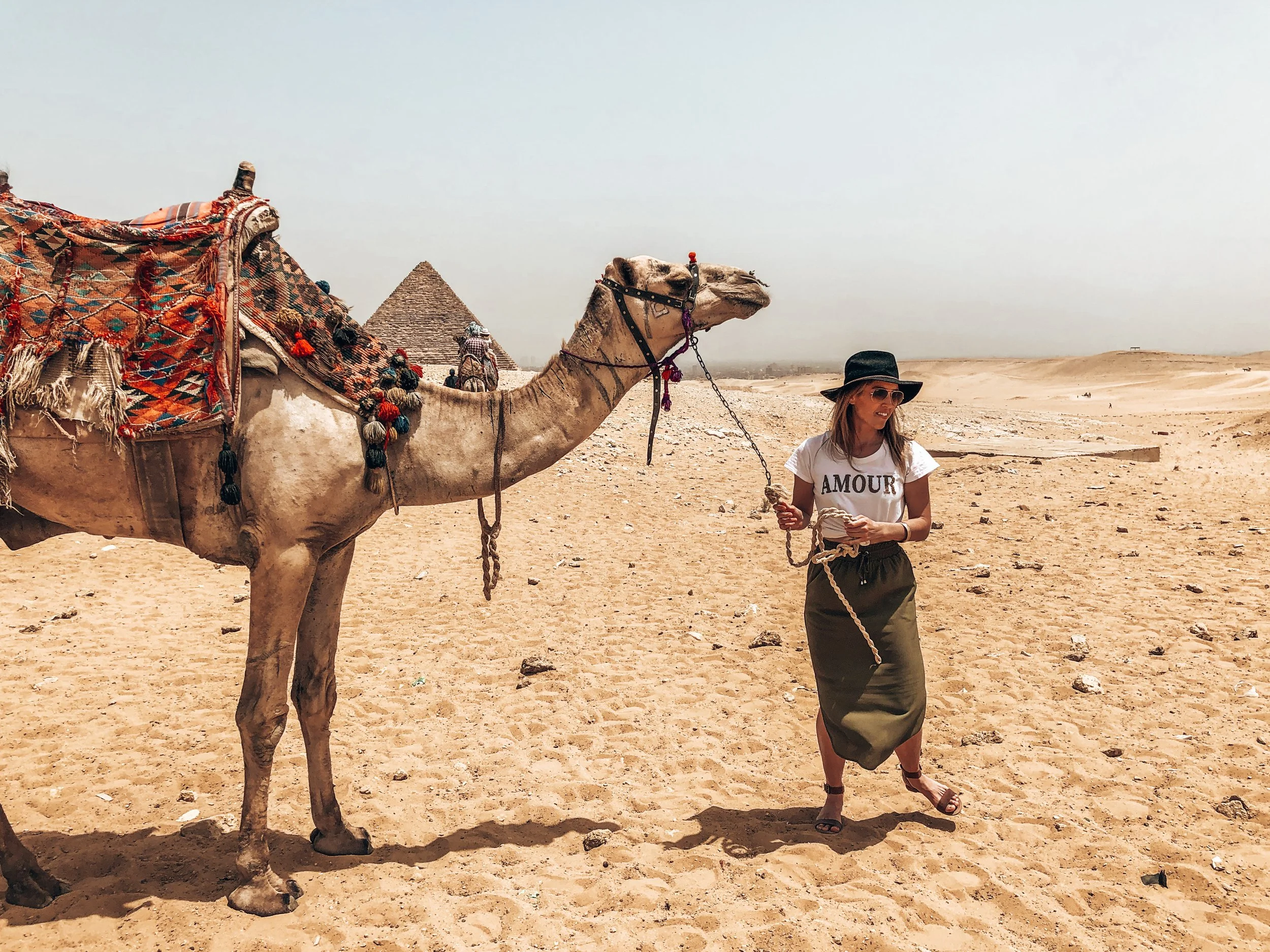
Seeing the pyramids with my own eyes was a real “pinch me” moment.
Egypt is one of those places where the reality can feel almost impossible to process. You can spend the morning standing in front of the pyramids you’ve seen in photographs your entire life, then a few hours later be walking through a temple covered in hieroglyphics that has been standing for thousands of years.
I grew up reading books about the world's ancient wonders, so Egypt had been sitting somewhere on my bucket list for years. But when I finally visited, it wasn't quite the trip I had imagined… It was more intense. More chaotic. More fascinating. And, at times, more challenging.
I travelled as part of a group, which gave me the structure and support I wanted for my first trip to Egypt. It also meant I could spend less time worrying about logistics and more time taking in what was actually in front of me.
From the pyramids at Giza to the temples of Luxor, sailing the Nile on a traditional felucca and seeing Abu Simbel in person, Egypt packed an enormous amount into one trip.
If you only have a week, you obviously can't see everything. But you can see a lot.
This 7 day Egypt itinerary is designed to give you a taste of the country's biggest ancient sites while also including some of the experiences that make Egypt feel like more than a checklist of archaeological sites.
7 Day Egypt Itinerary at a Glance
Day 1: Cairo and the Pyramids of Giza
Day 2: Grand Egyptian Museum, Saqqara and Islamic Cairo
Day 3: Fly to Luxor + Karnak Temple and Luxor Temple
Day 4: Valley of the Kings, Hatshepsut Temple and Luxor's West Bank
Day 5: Travel from Luxor to Aswan via Edfu and Kom Ombo
Day 6: Aswan, Philae Temple and a Nubian village
Day 7: Abu Simbel + return to Cairo
Is 7 days enough for Egypt?
Seven days is enough for a highlights trip to Egypt, but it isn't enough to see everything.
For a first visit, I'd prioritise Cairo/Giza, Luxor, Aswan, the Nile and Abu Simbel. Alexandria, the Red Sea, Siwa Oasis and the White Desert are better saved for a longer trip.
The biggest mistake would be trying to add every possible destination and spending your entire holiday sitting in airports, cars and buses.
Before You Start: A Few Things to Know About This Itinerary
Egypt looks relatively compact on a map, but distances can be deceptive.
This itinerary works because it follows a fairly logical route:
Cairo → Luxor → Aswan → Abu Simbel → Cairo
You'll need to use a combination of flights, road transfers and/or a Nile cruise depending on how you choose to travel (to fit the itinerary into 7 days).
I've deliberately built the itinerary around early mornings and efficient transfers. Egypt's major archaeological sites can be hot, busy and physically tiring, so getting started early can make a huge difference.
A note about travelling in Egypt
I chose a group tour for my own trip partly because I wanted the extra support and organisation. My experience wasn't the same as travelling independently, and I wouldn't suggest that everyone needs to travel Egypt the same way.
But I would recommend going into the trip prepared.
There are plenty of things I wish I'd known before visiting, from dealing with persistent vendors to navigating security, long travel days and local customs.
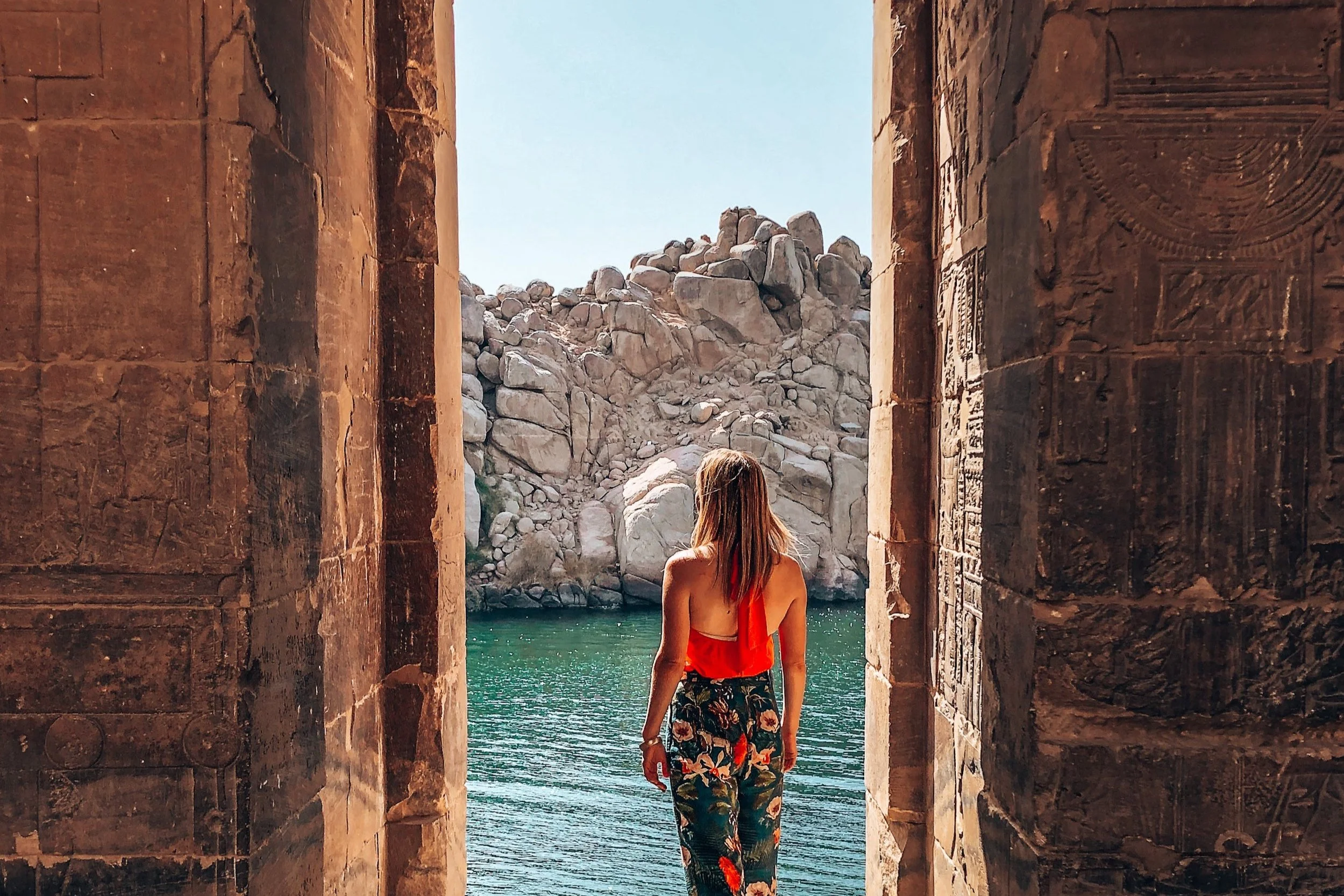
A temple only accessible by boat.
Day 1: Cairo + The Pyramids of Giza
Start with the sight you've been waiting for
If you're anything like me, the first day in Egypt is going to feel slightly surreal.
Because no matter how many photographs you've seen, the Pyramids of Giza are still the Pyramids of Giza… and they're enormous.
I remember the strange feeling of finally seeing something I'd spent years seeing in books and photographs. There's something about standing in front of an ancient monument rather than looking at it through a screen that makes the scale suddenly hit you.
Visit the Pyramids of Giza
Start your Egypt itinerary at the Giza Plateau, home to the three famous pyramids:
Great Pyramid of Khufu
Pyramid of Khafre
Pyramid of Menkaure
The Great Pyramid is the oldest and largest of the three and the only surviving Wonder of the Ancient World.
Give yourself plenty of time to explore the plateau rather than simply arriving, taking the obligatory photograph and leaving. Walk around the complex and take in the changing perspectives.
And yes, you'll probably be approached by people offering camel rides, souvenirs, photographs or other services. I chose not to ride a camel and walked around the site instead. You absolutely don't need an animal ride to experience the pyramids.
Tip: Go early
The earlier you can get to Giza, the better. You'll have cooler temperatures, softer light for photography and a better chance of experiencing the pyramids before the biggest crowds arrive.
See the Great Sphinx
The Great Sphinx of Giza is another one of those moments where you realise you're looking at something you've seen your entire life.
Give yourself time to actually look at it rather than treating it as a quick photo stop. The Sphinx is particularly impressive when you consider its age and the amount of history that has happened around it.
Should you go inside a pyramid?
This is completely personal. If entering one of the pyramids is something you've always wanted to do, research the options before your visit and decide whether the experience is worth it for you.
The interiors can be physically challenging, particularly if you don't enjoy confined spaces. For me, the real magic was being outside and seeing the pyramids as part of the wider landscape.
Spend the afternoon exploring Cairo
After Giza, head back towards Cairo.
Depending on your energy levels, you could spend the afternoon exploring:
Khan el-Khalili
Islamic Cairo
Al-Azhar area
Cairo's historic streets
The Citadel of Cairo
The Mosque of Muhammad Ali
Khan el-Khalili is particularly atmospheric, but it can also be intense. Go expecting to be approached by vendors and remember that browsing doesn't mean you have to buy.
Egypt travel tip
Don't feel pressured to say yes simply because someone is friendly or persistent. A polite but firm "no, thank you" is often enough.
Day 2: Grand Egyptian Museum + Saqqara
Day two is about putting everything you've seen into context. Because after standing in front of the pyramids, you're going to want to understand the civilisation that built them.
Visit the Grand Egyptian Museum
The Grand Egyptian Museum (GEM) is now an important addition to a Cairo itinerary and sits close to the Giza Plateau.
It's worth allowing several hours rather than treating it as a quick museum visit. The museum's collection spans Egyptian history from prehistoric periods through the Roman period, with major galleries dedicated to ancient Egypt.
Check the official museum website before your visit for current opening hours, ticket availability and photography rules.
Why visit the museum after Giza?
Seeing the monuments first gives the museum more context.
Instead of looking at an ancient artefact as something interesting behind glass, you've already walked through the landscape where this civilisation developed. That makes the history feel much more tangible.
Explore Saqqara
If you have the time, I'd make Saqqara a priority. It's one of the additions I'd recommend for travellers who want to go slightly beyond the standard Giza itinerary.
Saqqara is home to the famous Step Pyramid of Djoser, one of the earliest monumental stone structures in Egypt. The wider Memphis and Saqqara area is also important for understanding how Egyptian pyramid building developed.
Why I like adding Saqqara
Giza is the obvious bucket-list stop. Saqqara gives you another perspective. It's a chance to see more ancient Egyptian history without spending your entire trip standing in the same few famous locations.
Optional: Dahshur
If your schedule allows, continue to Dahshur, where you'll find the Bent Pyramid and Red Pyramid.
This is a great option for travellers who are particularly fascinated by ancient Egyptian architecture. If you have to choose between adding Dahshur and having a slower afternoon in Cairo, I'd choose based on your interests.
History nerd? Add Dahshur. Already feeling exhausted? Slow down. Seven days is fast enough without turning every day into an archaeological marathon.
Day 3: Fly to Luxor + Karnak Temple
Today you leave Cairo and head south to Luxor.
Luxor is where Egypt starts to feel completely ridiculous in the best possible way. The concentration of ancient sites here is incredible.
Explore Karnak Temple
Make Karnak Temple your first major stop.
This isn't a quick temple visit. Karnak is a huge complex of temples, chapels, pylons and monuments that developed over many centuries.
The Great Hypostyle Hall is particularly impressive, with its enormous forest of columns. And this is where having a knowledgeable guide can make a huge difference. Without context, you can walk through ancient ruins and see columns.
With an Egyptologist explaining what you're looking at, suddenly the walls, gods, hieroglyphics and rituals start to make sense.
Visit Luxor Temple
Finish your first day in Luxor at Luxor Temple. Its location makes it particularly easy to combine with Karnak.
The temples were historically connected by an avenue lined with sphinxes, and the relationship between the two sites gives you a better understanding of ancient Thebes.
If you have the opportunity to see Luxor Temple later in the day, do it. The atmosphere changes completely as the light fades.
Stay in Luxor
Luxor is one of the places where choosing accommodation carefully can make your itinerary easier.
You can stay on the:
East Bank: Convenient for Karnak, Luxor Temple, restaurants and the main city.
West Bank: Quieter and closer to many of the archaeological sites.
For a short trip, I'd prioritise convenience over trying to find the most remote or atmospheric accommodation. You've got a lot to see.
Day 4: Valley of the Kings + Luxor's West Bank
Today is one of the biggest days of the itinerary. Get up early. Seriously.
Visit the Valley of the Kings
Cross the Nile to Luxor's West Bank and head towards the Valley of the Kings.
This was the burial ground for many rulers of Egypt's New Kingdom and contains more than 60 tombs, along with additional unfinished tombs.
But the number isn't really what makes the experience memorable. It's what's inside… the colours and details on the walls can be extraordinary. After thousands of years, you're still looking at scenes and symbols that were created to accompany people into the afterlife.
I found this one of the most fascinating parts of travelling through Egypt.
Don't just focus on Tutankhamun
Tutankhamun's tomb is obviously famous, but don't assume it's automatically the most impressive tomb you'll visit. Some of the other tombs have incredible artwork and decoration. Your ticket may include a set number of tombs, with additional tombs requiring separate tickets, so check the current options when planning your visit.
Tip: Don't arrive at midday
The West Bank can get extremely hot. An early start isn't just about avoiding crowds. It can make the entire experience more comfortable.
Visit the Temple of Hatshepsut
Continue to the Temple of Hatshepsut at Deir el-Bahari.
The temple is built dramatically against the cliffs, which makes it one of those Egyptian sites that photographs well but feels even more impressive in person.
Hatshepsut herself is one of the most fascinating figures to learn about during a visit to Egypt. This is another reason I'd strongly recommend travelling with an Egyptologist or knowledgeable local guide.
See the Colossi of Memnon
Make a quick stop at the Colossi of Memnon. The enormous statues are an easy addition to a West Bank itinerary and don't require hours of your day.
Optional: Valley of the Queens
If ancient Egyptian history is your thing and you have the energy, consider adding the Valley of the Queens. It's often overlooked compared with the Valley of the Kings. That's exactly why it can appeal to travellers who want to dig a little deeper.
Day 5: Luxor → Edfu → Kom Ombo → Aswan
Today is less about ticking off one attraction and more about experiencing Egypt's most famous natural highway… the Nile.
This is where I'd ideally build a Nile cruise into the itinerary. If you don't want to do a conventional cruise, you can arrange the journey by road and stop at the temples independently, but you'll need to plan the logistics carefully.
Stop at Edfu Temple
The Temple of Edfu is dedicated to Horus and is one of the best-preserved ancient Egyptian temples. Walking through the entrance gives you another glimpse into how enormous these temple complexes once were. And unlike some of the more famous Egyptian sites, Edfu can feel like a discovery rather than the main event.
Visit Kom Ombo Temple
Continue towards Kom Ombo. This temple is unusual because it has a symmetrical double design dedicated to two different gods: Sobek and Horus. There's also a fascinating connection to ancient medicine, with reliefs depicting surgical instruments.
Travel tip
Edfu and Kom Ombo work particularly well as part of a Nile itinerary because you don't have to organise separate return journeys from Aswan. Instead, the river becomes part of your transport. And that's exactly the kind of travel experience I love. You're not just moving between attractions. You're actually travelling through the country.
Arrive in Aswan
Aswan has a noticeably different feel from Cairo and Luxor. It's further south, closer to Nubia, and the Nile becomes a much bigger part of the landscape. Don't over-plan your first evening. Have dinner, walk along the waterfront and enjoy the change of pace. You've earned it.
Day 6: Aswan + Philae Temple + Nubian Village
Aswan was one of my favourite parts of the trip because it gave me more opportunities to experience Egypt beyond the major monuments.
Visit Philae Temple
Start with Philae Temple.
The temple complex is dedicated primarily to Isis and sits on Agilkia Island after being relocated as part of the international effort to save the monuments from flooding caused by the Aswan High Dam.
That story alone adds another layer to the visit. You aren't just looking at an ancient temple… you're looking at a monument that was physically moved to save it. And you'll arrive by boat, which makes the experience feel even more memorable.
See the Unfinished Obelisk
If you have time, visit the Unfinished Obelisk. It's a fascinating reminder that ancient Egyptian monuments weren't simply appearing fully formed.
You can see the unfinished stone still connected to the quarry, giving you a glimpse into the practical process behind some of Egypt's monumental architecture.
Visit a Nubian Village
This is where I'd make room for something that isn't another ancient temple. Visit a Nubian village and spend some time experiencing the local culture.
The exact experience will depend on who you travel with, but you may have the opportunity to visit a local home, learn about Nubian traditions, share food or tea and see a different side of southern Egypt.
This was one of the experiences that reminded me that Egypt isn't just about ancient history. There are people living here now, with cultures, traditions and stories that are every bit as important to understanding the country.
Traveller tip
Choose experiences that give you a genuine opportunity to interact respectfully with local communities rather than treating someone's home or culture as a photo opportunity.
Optional: Sail the Nile on a Felucca
If you have the opportunity to spend a night on a traditional Nile felucca, I would seriously consider it.
This was one of the most memorable experiences of my Egypt trip.
We swapped a comfortable hotel for a mattress on the deck of a traditional sailing boat, sleeping beneath the stars on the Nile. There were sunsets, sunrises, village views, food, music and plenty of time simply sitting on the river.
It wasn't luxury. It was better than luxury. It felt like we were actually travelling.
Read next: Sailing the Nile on a Felucca: My Unforgettable Egypt Adventure
Important
A felucca experience isn't for everyone. There are limited facilities, you're exposed to the weather and you'll be sharing the space with your group. But if you're the kind of traveller who would rather have an unforgettable story than another five-star hotel night, this is worth considering.
Day 7: Abu Simbel + Return to Cairo
If there is one day on this itinerary that requires an early alarm, it's this one.
Visit Abu Simbel
Travel south from Aswan to Abu Simbel, close to Egypt's border with Sudan.
The temples were commissioned by Ramesses II and carved into the rock. The four enormous seated statues outside the Great Temple are the image most people recognise, but the interior is just as fascinating.
There is also a second temple dedicated to Hathor and Queen Nefertari. And there's an incredible story behind the entire site.
When construction of the Aswan High Dam threatened to flood the temples, they were dismantled and relocated to higher ground as part of an international UNESCO-led effort. So the Abu Simbel you visit today isn't sitting in its original position. It's an enormous archaeological rescue project. That makes seeing it even more impressive.
How to visit Abu Simbel
From Aswan, Abu Simbel can be visited as a long day trip or as part of a longer Lake Nasser itinerary. For a seven-day trip, a day trip is the simplest option.
It does mean another early start and a long travel day, so factor that into your expectations. If you know you struggle with consecutive early mornings, you may prefer to spend an additional night in Aswan and fly back to Cairo the following day.
Return to Cairo
Depending on your transport arrangements, return to Cairo on day seven and either:
stay overnight before flying home the next day
connect directly with an international flight if the timings work
add an extra night in Cairo if your schedule allows
I would strongly recommend an overnight buffer if you can afford the extra night.
Egypt involves a lot of moving parts, and giving yourself some breathing room is much better than building an international flight connection around a tight domestic transfer.
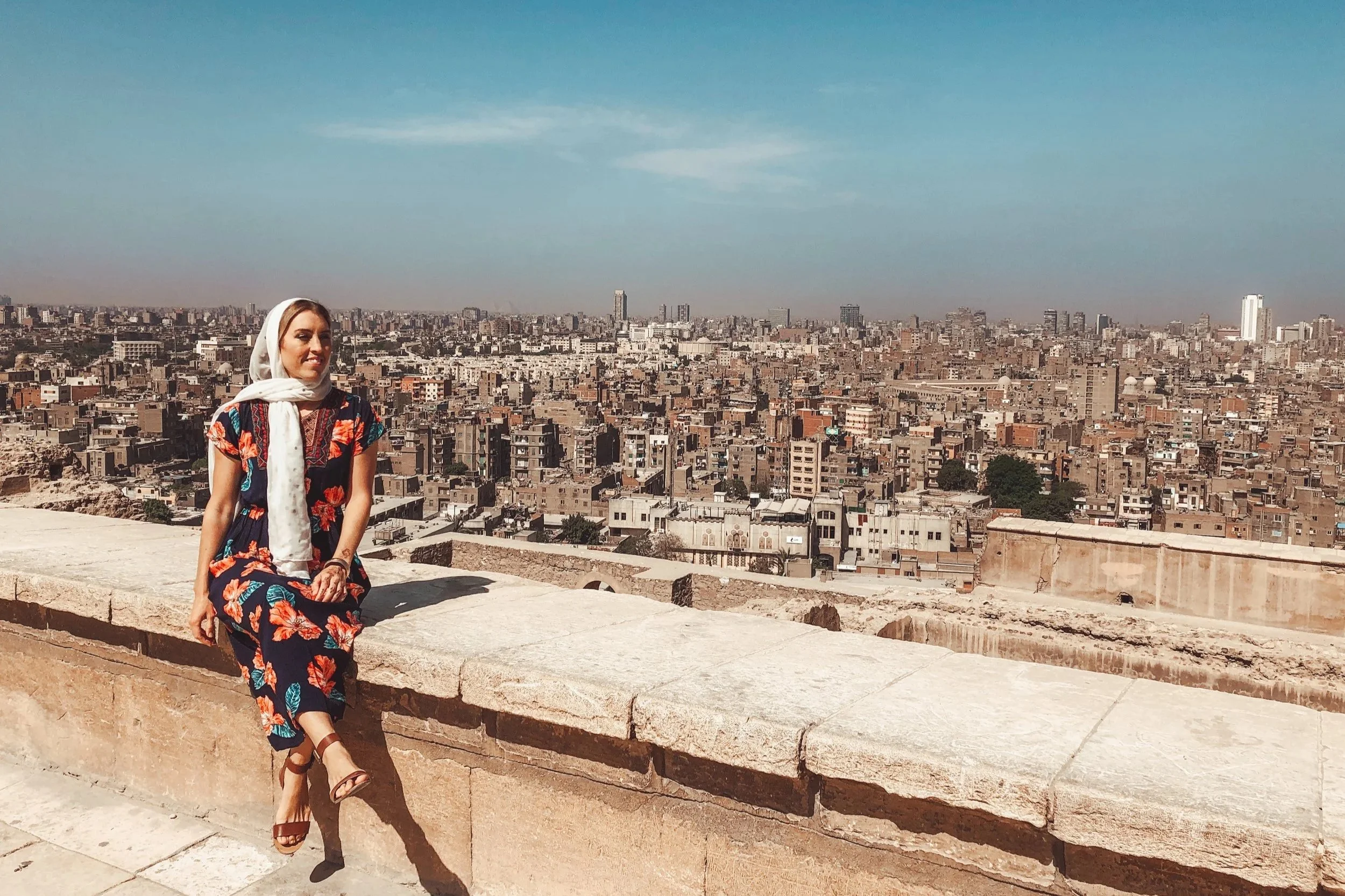
I love the blend of history and modern day in Egypt.
What About Alexandria?
I haven't included Alexandria in this seven-day itinerary deliberately.
It's absolutely worth visiting, particularly if you're interested in:
the Bibliotheca Alexandrina
Qaitbay Citadel
Catacombs of Kom El Shoqafa
Greco-Roman history
Mediterranean coastal culture
But adding Alexandria means taking time away from Cairo, Luxor or Aswan.
If you have 8–10 days, I'd consider adding Alexandria. If you only have seven days, I'd save it for another trip.
What About the Red Sea?
The same goes for Egypt's Red Sea resorts.
Hurghada, Sharm El Sheikh and the Red Sea coast are excellent additions if you want:
snorkelling
diving
coral reefs
marine life
a few slower beach days
But I wouldn't try to squeeze a Red Sea resort into this itinerary. Egypt is already giving you a lot in seven days.
What About Siwa Oasis?
If you have more time and want something completely different, look at Siwa Oasis. It's a much bigger detour from the classic Cairo-Luxor-Aswan route, but that's also what makes it interesting.
Siwa is particularly appealing if you want:
desert landscapes
oasis scenery
a slower pace
Berber/Amazigh culture
salt lakes
fewer major tourist crowds
I'd save it for a longer Egypt trip rather than attempting to tack it onto this one.
How to Make This 7 Day Egypt Itinerary More Relaxed
Let's be honest… this is not a slow holiday. Seven days in Egypt is a highlights trip. You're going to have early starts, long travel days and plenty of walking.
If you want a slower experience, I'd stretch this itinerary to 10-14 days. The easiest places to add extra time are:
Add 1 day in Cairo
Use it for:
Coptic Cairo
Islamic Cairo
Khan el-Khalili
Saqqara
Dahshur
more time at the Grand Egyptian Museum
Add 1 day in Luxor
This would give you time for:
Valley of the Queens
Medinet Habu
Deir el-Medina
more temples
a slower West Bank experience
Add 1-2 days in Aswan
This gives you time for:
Nubian villages
felucca sailing
Elephantine Island
Nubian Museum
more time on the Nile
a more relaxed Abu Simbel trip
Where to Stay on a 7 Day Egypt Trip
Because you're moving around so much, location matters.
Cairo
Stay somewhere that makes getting to Giza and the airport relatively straightforward. If seeing the pyramids from your hotel is a bucket-list moment, a Giza hotel can be worth considering. If you want restaurants, nightlife and easier access to central Cairo, look at central neighbourhoods instead.
Luxor
The East Bank is convenient for the city, restaurants and Luxor Temple.The West Bank is quieter and closer to many of the archaeological sites.
Aswan
Stay somewhere along the Nile if your budget allows. The river is the reason to be here.
How Much Does 7 Days in Egypt Cost?
Your budget will vary dramatically depending on how you travel.
The biggest variables are:
accommodation
domestic flights
private guides
group tours
Nile cruise vs independent travel
entrance fees
transport
restaurants
Abu Simbel transfers
optional experiences
Budget for more than just the headline price
When comparing Egypt tours or itineraries, check what's actually included.
A cheaper-looking itinerary can become much more expensive once you add:
domestic flights
airport transfers
entrance fees
guide fees
tips
additional tomb tickets
optional excursions
Abu Simbel transport
What to Pack for Egypt
For this itinerary, I'd prioritise practical clothing over trying to build a fashionable travel wardrobe.
Pack:
lightweight breathable clothing
comfortable walking shoes
a hat
sunglasses
sunscreen
reusable water bottle
power bank
small day bag
modest clothing for religious sites
scarf or lightweight layer
medications and basic first-aid supplies
hand sanitiser
tissues
comfortable clothes for long travel days
If you're doing a felucca, pack for a much more basic experience. You don't want to drag your entire suitcase onto a traditional sailing boat.
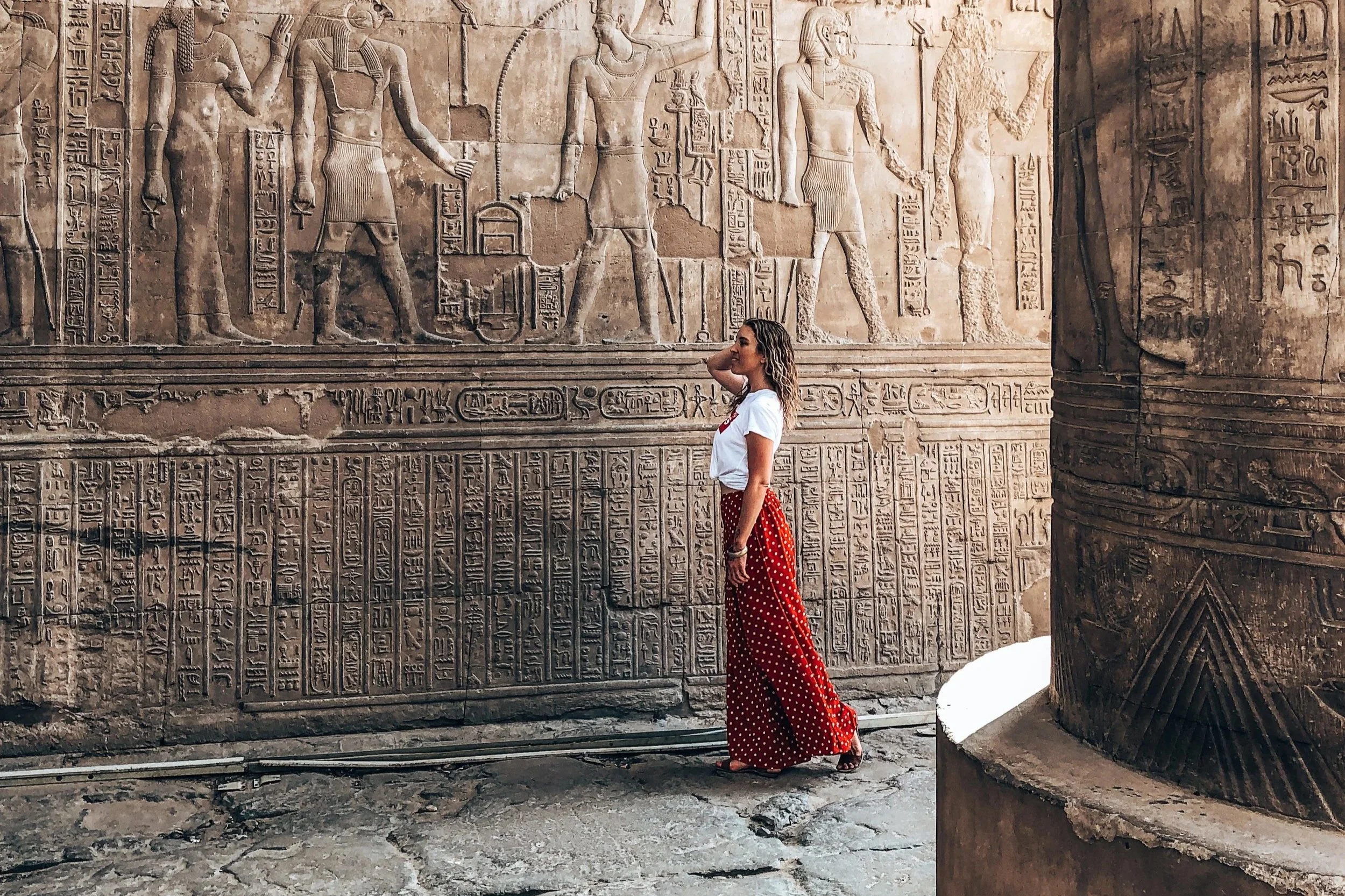
Walking through history.
Egypt Travel Tips I Wish I'd Known Before My Trip
1. Don't underestimate the distances
Egypt looks manageable on a map. It isn't always. Build realistic travel time into your itinerary.
2. Start early
This is one of my biggest tips. Early mornings can mean cooler temperatures, fewer people and better photography.
3. Wear comfortable shoes
Ancient temples are not designed around modern travellers' feet. You'll walk more than you think.
4. Bring cash
Don't assume you'll be able to use a card everywhere. Have smaller notes available for tips and small purchases.
5. Expect to be approached
Egypt's tourist sites can involve persistent vendors and people offering services. Prepare for it before you arrive so you're not caught off guard.
6. Be respectful with photography
Photography rules vary between sites and can change. Always check the rules before photographing people, religious spaces, museum interiors or restricted areas.
7. Don't try to see everything
This is perhaps the most important tip. Egypt has thousands of years of history. You aren't going to finish it in a week. Pick the experiences that matter most to you.
Is This the Best 7 Day Egypt Itinerary?
There's no single perfect Egypt itinerary… it depends on what you want from the trip.
If your priority is ancient Egypt, this route works particularly well because it concentrates your time around Cairo, Luxor and Aswan. If your priority is beaches and marine life, I'd build the itinerary differently. If your priority is desert landscapes, I'd swap in Siwa or the White Desert.
And if your priority is slow travel, I'd add several days rather than trying to squeeze more destinations into the same seven.
For a first trip, though, I think there's something special about following the Nile south. You start with the pyramids. Then you move through the ancient temples of Luxor. You watch the landscape change as you travel towards Nubia. You sail the Nile. And eventually you arrive at Abu Simbel, staring up at enormous statues carved into the rock.
It's a lot to take in.
Frequently Asked Questions About Visiting Egypt for 7 Days
Can you see Egypt in 7 days?
Yes. Seven days is enough to see the major highlights, particularly Cairo, Giza, Luxor, Aswan and Abu Simbel. It isn't enough to see every major destination in Egypt, so you'll need to prioritise.
How many days do you need in Egypt?
I'd recommend 10-14 days if you want a more relaxed first trip. Seven days works well for a highlights itinerary, while two weeks gives you room to add destinations such as Alexandria, the Red Sea, Siwa Oasis or additional time in Luxor and Aswan.
Is Cairo worth visiting?
Absolutely. Even if your main reason for visiting Egypt is the ancient temples and tombs further south, Cairo gives you an important introduction to the country and makes it easy to combine Giza, museums and historic neighbourhoods.
Is Luxor worth visiting?
Luxor is one of the most important stops for anyone interested in ancient Egyptian history. Karnak Temple, Luxor Temple, the Valley of the Kings and the West Bank can easily fill several days.
Is Abu Simbel worth the long journey?
For travellers interested in ancient Egypt, Abu Simbel is a major highlight. The temples are spectacular and their relocation during the construction of the Aswan High Dam adds an extraordinary modern chapter to their history.
Can you do Egypt without a tour?
Yes, it is possible to travel independently. However, transport logistics, guides, transfers and navigating major tourist sites can add complexity. I chose a group tour for my own trip because I wanted the additional organisation and support.
Should you take a Nile cruise?
A Nile cruise is one option for travelling between Luxor and Aswan and allows you to visit sites such as Edfu and Kom Ombo along the way. If you'd prefer something smaller and more adventurous, a traditional felucca offers a very different experience.
What is the best time to visit Egypt?
The cooler months are generally more comfortable for sightseeing, particularly if you're spending long periods outdoors at archaeological sites. Summer can be extremely hot, especially in southern Egypt.
Always check conditions and opening hours close to your trip because schedules, access and ticketing can change.
My 7 Day Egypt Itinerary
Egypt wasn't the easiest country I've travelled through. But it was one of the places that reminded me why I travel in the first place.
There were moments that felt overwhelming. Moments that were chaotic. Moments where I definitely wished I'd known a little more before arriving.
And then there were the moments I had dreamed about for years… standing beneath the pyramids… walking through ancient tombs… looking up at the columns of Karnak… sailing down the Nile on a felucca as the sun disappeared… and standing in front of Abu Simbel wondering how people thousands of years ago managed to create something on that scale.
Egypt is not a destination I'd describe as effortless. But if ancient history, incredible landscapes and experiences that stay with you long after you get home are what you're looking for, it deserves a place on your travel list.
Just don't try to see the whole country in seven days. Choose your priorities, leave some breathing room and give yourself time to actually experience Egypt rather than simply ticking it off.
More Egypt Travel Guides
Planning an Egypt trip? These guides can help you go beyond the itinerary:
20 Things I Wish I Knew Before Visiting Egypt: My practical guide to safety, culture, transport, food, dress, photography, tipping and the things that surprised me most.
Sailing the Nile on a Felucca: My Unforgettable Egypt Adventure: What it's actually like to swap a hotel for a traditional felucca and spend the night sailing the Nile.